150 years ago today, the United States–a nation mired in the fourth
year of a bloody Civil War–was celebrating the anniversary of its
independence from Great Britain. In the ranks of the vast Union armies
fighting to preserve that nation, the significance of the day did not go
unnoticed.
On July 4, 1864, hundreds of thousands of Union soldiers were spread
out across the Southern United States, occupying lands of the
Confederacy in what was the final year of the American Civil War. Most
notably, two Union commanders were on the precipice of seizing major
southern cities. In Virginia, Grant was settling in near Petersburg,
beginning a months long siege that would force he and his men to wait
until 1865 until their goals of victory in the campaign for Richmond
could be realized.
Far to the south, in the state of Georgia, William Tecumseh Sherman’s
army group, consisting of the Army of the Cumberland, the Army of the
Tennessee, and the Army of the Ohio, rested just miles from Kennesaw
Mountain, the imposing height which had stalled Sherman for the latter
half of June and the first several days of July. It had only been on the
morning of July 3rd that Union soldiers discovered that Confederates
had vacated their Kennesaw trenches, having been forced out by yet
another flanking maneuver from Sherman. Kennesaw Mountain had been a
resounding defeat for Sherman’s men, as each attacking column the
Federals sent forward on the morning of June 27, 1864, was handsomely
repulsed. Yet, one week later, the Confederates had retreated, and the
Union soldiers who had seen their comrades slaughtered in such great
number in front of the Kennesaw Line were preparing to push for the
Chattahoochee River and toward Atlanta itself.
Thus, 150 years ago, Union soldiers had cause for both sadness and
gratefulness, for both remorse and relief. The troubles of Kennesaw
Mountain were past, yet the struggle for Atlanta lay firmly in their
future.
“One year ago were in Shellbyville Tenn. Wonder next 4th will
find us, or me. Enjoying the blessings of peace, I hope. Hardly think it
will. One consolation, my term of service will have nearly expired.
Weather very warm. A man would have been called insane three years ago,
who would have prophesied that the war would last till July 1864”
O.M. Scott, Commissary Sergeant, 121st Ohio Volunteer Infantry
“This is a holiday to all Americans whether it will be so to us remains to be seen.”
Sgt. Israel Connell, 51st Ohio Volunteer Infantry
“We are celebrating the birthday of the Nation by firing an
occasional salute on the works of the foe in our front. Company E was on
the skirmish line all day, and it was very interesting. A year ago we
were at Shelbyville, Tenn., and on that day Vicksburg was taken by
General Grant. Where will we be July 4th, 1865?”
Francis McAdams, 113th Ohio Volunteer Infantry
“Thankful should we be to Divine Providence that our ever honored
and memoriable National Birthday is thus made the more sacred by a
victory over the Nation’s and Freedom’s enemies.”
Albert Champlin, 105th Ohio Volunteer Infantry
Showing posts with label Kennesaw Mountain. Show all posts
Showing posts with label Kennesaw Mountain. Show all posts
Friday, July 4, 2014


Wednesday, January 1, 2014
New Year, New Blog
Happy New Year!!
Now that it is 2014, the 150th anniversary of the Atlanta Campaign and Kennesaw Mountain is here. Because my book on Kennesaw will be out in a few months, I am starting and launching a new blog on Kennesaw Mountain and the Atlanta Campaign: www.kennesawmountain.wordpress.com.
Please check out the new site, which will have a definite focus on Kennesaw Mountain, as the title states, as well as William Tecumseh Sherman, Joseph Johnston, and the others who fought in Georgia during the summer of 1864.
Don't worry, I will still be posting regularly on here as well, and probably posting some things on both blogs. Thanks for your comments and continuing to visit this site. I really enjoy maintaining this blog, and look forward to starting a new one in this new year!
Now that it is 2014, the 150th anniversary of the Atlanta Campaign and Kennesaw Mountain is here. Because my book on Kennesaw will be out in a few months, I am starting and launching a new blog on Kennesaw Mountain and the Atlanta Campaign: www.kennesawmountain.wordpress.com.
Please check out the new site, which will have a definite focus on Kennesaw Mountain, as the title states, as well as William Tecumseh Sherman, Joseph Johnston, and the others who fought in Georgia during the summer of 1864.
Don't worry, I will still be posting regularly on here as well, and probably posting some things on both blogs. Thanks for your comments and continuing to visit this site. I really enjoy maintaining this blog, and look forward to starting a new one in this new year!
Monday, February 11, 2013
Southern Comfort Zone
The title of this post is NOT about the Atlanta airport.
My flight yesterday was scheduled for 4:26 pm. We did not leave Atlanta until after 9 pm. Twice, our plane was found mechanically faulty, and another was brought in. Three times our gate was switched. There were severe thunderstorms across the South, making travel a nightmare.
But, after leaving my Aunt and Uncle's house in Kennesaw at 2 pm yesterday, I finally got home in Ohio at right around midnight. A very long day indeed.
However, I still love Georgia (if not Delta Airlines). I am glad to be back home in Ohio, safe and sound, because I have quite a bit of work ahead of me on the book project, as well as putting the finishing touches on and hopefully publishing my Antietam research. Also, I don't mind leaving Georgia too much because, as the Brad Paisley song goes,

My flight yesterday was scheduled for 4:26 pm. We did not leave Atlanta until after 9 pm. Twice, our plane was found mechanically faulty, and another was brought in. Three times our gate was switched. There were severe thunderstorms across the South, making travel a nightmare.
But, after leaving my Aunt and Uncle's house in Kennesaw at 2 pm yesterday, I finally got home in Ohio at right around midnight. A very long day indeed.
However, I still love Georgia (if not Delta Airlines). I am glad to be back home in Ohio, safe and sound, because I have quite a bit of work ahead of me on the book project, as well as putting the finishing touches on and hopefully publishing my Antietam research. Also, I don't mind leaving Georgia too much because, as the Brad Paisley song goes,
Cause I know the route I leave on
It will always bring me back
It will always bring me back
(Hopefully the route leading me back will not be a Delta flight with a 5 hour delay and turbulence from thuderstorms, but I agree with Brad's general sentiment)
A big thanks to the folks at Emory University's Manuscript and Rare Book Library in the Woodruff Library Building, the staff at the Atlanta History Center, and most importantly, the Kennesaw Mountain National Battlefield Park Staff, including Park Historian Willie Johnson and Ranger Amanda Corman. I also want to thank local historian Brad Quinlin who spent several hours going over Kennesaw Mountain while walking the ground with me this past Friday.

So long Kennesaw Mountain, see you next time.
Now, I just need to hunker down in this Ohio winter to continue working on this book...
Saturday, February 9, 2013
Flying Home to Ohio
Sadly, my time in Georgia has come to an end. Today, it was in the 60s and sunny. Tomorrow, I fly back to Cleveland, where assuredly, the sun will not shine again until sometime in mid-June, and there will still be snow on the ground when the Indians open their season in April.
But, my stay in Georgia was wonderful, as always. I love spending time with my Uncle Jeff and Aunt Paula, and I have had an amazing trip for researching, hiking, and getting to know the battle of Kennesaw Mountain much better than I ever did before. If one is going to write about history, no matter what kind, I am thoroughly convinced that experiencing things first hand is crucial. Walking the ground of battlefields, touring historic homes, or even just being in the same places as historical figures always helps the writing process.
For me, spending time hiking the many trails at Kennesaw Mountain is very important. Because this was my last full day in Georgia, I saved the biggest, best known trail for last.

The land behind me is the ground over which Union and Confederate forces struggled during the Atlanta Campaign in the lead up to the fight at Kennesaw Mountain in June. In the distance are the fields of Pickett's Mill, Resaca, and Rocky Face Ridge.


And many miles further is Cleveland, where I head tomorrow. It has been a great trip, and it has reminded me why I love the South so much. I can't wait to come back. But, for now, it is publishing Antietam research, writing my Kennesaw Mountain book, hoping for a new season at Antietam, and awaiting what else God has in store for me.
But, my stay in Georgia was wonderful, as always. I love spending time with my Uncle Jeff and Aunt Paula, and I have had an amazing trip for researching, hiking, and getting to know the battle of Kennesaw Mountain much better than I ever did before. If one is going to write about history, no matter what kind, I am thoroughly convinced that experiencing things first hand is crucial. Walking the ground of battlefields, touring historic homes, or even just being in the same places as historical figures always helps the writing process.
For me, spending time hiking the many trails at Kennesaw Mountain is very important. Because this was my last full day in Georgia, I saved the biggest, best known trail for last.
Today, Jeff and I hiked up Big Kennesaw, all 1808 feet.
The land behind me is the ground over which Union and Confederate forces struggled during the Atlanta Campaign in the lead up to the fight at Kennesaw Mountain in June. In the distance are the fields of Pickett's Mill, Resaca, and Rocky Face Ridge.

Pumpkinvine Creek at Pickett's Mill Battlefield, a Georgia State Park
Further north are the blood soaked grounds of Chickamauga and Chattanooga

The Brotherton Cabin at Chickamauga
And many miles further is Cleveland, where I head tomorrow. It has been a great trip, and it has reminded me why I love the South so much. I can't wait to come back. But, for now, it is publishing Antietam research, writing my Kennesaw Mountain book, hoping for a new season at Antietam, and awaiting what else God has in store for me.
Wednesday, February 6, 2013
Today at Kennesaw Mountain Battlefield
I am spending the day hiking around Kennesaw Mountain.
What started out as a very foggy morning...
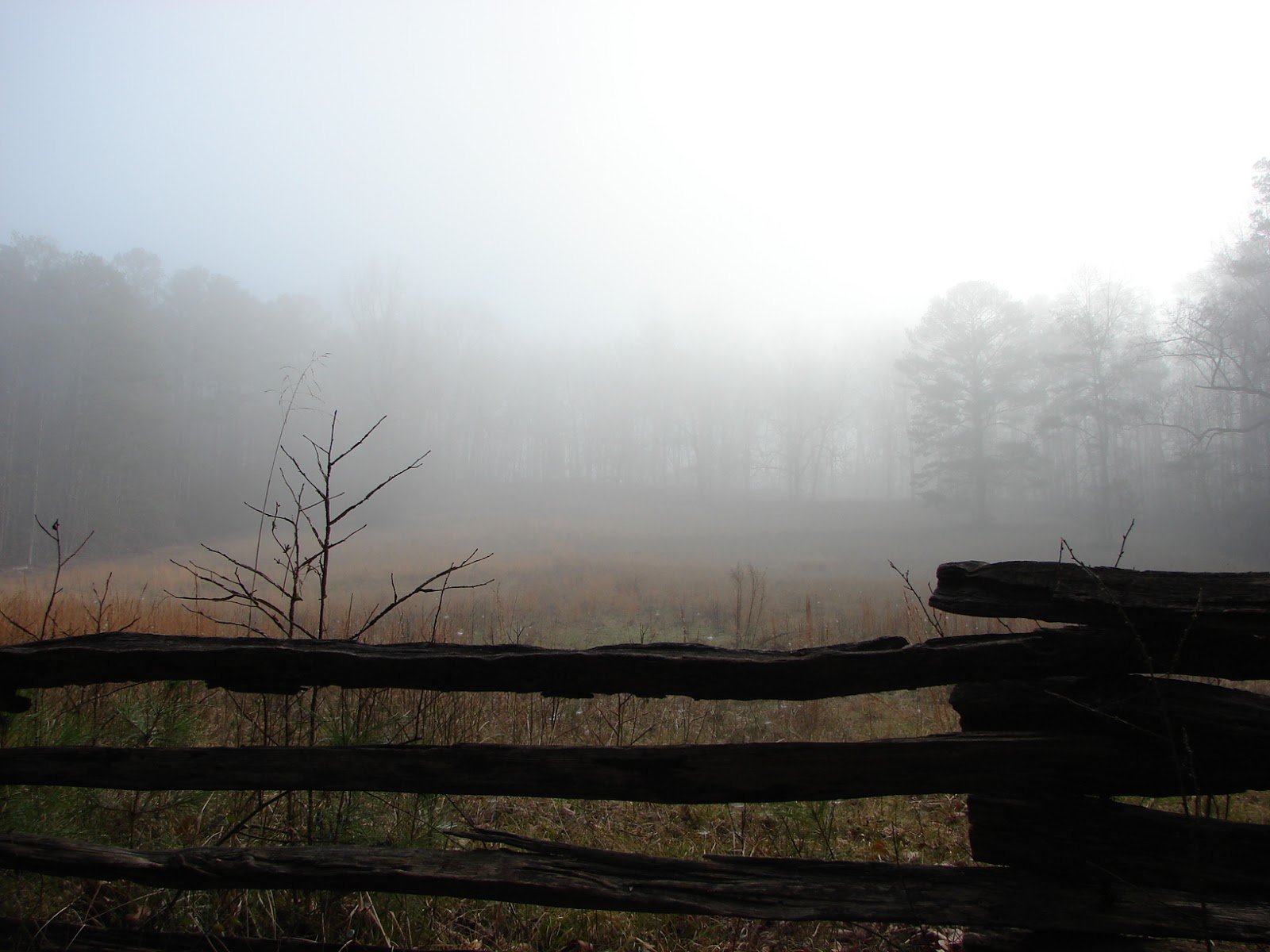

Has fast become a beautiful day.
Mid 60s, sun, and lots of trails on a battlefield to hike. What a great day to be in Georgia.


And I met a new friend today. This is Albert, the Kennesaw Mountain lizard
(or salamander, whatever).

Greetings from Georgia! I'm headed back out to hike the trails for the rest of the day!
Monday, October 29, 2012
Georgia Visit Postscript
Yesterday, I flew back to Ohio from Georgia. Judging from the wind and rain outside my window right now, it was not a moment too soon. While I love Georgia, and I love seeing my Uncle Jeff and Aunt Paula, who hosted me for a few days, being able to avoid the mess of cancelled flights and all the joys they bring is a big relief.
In the days and weeks ahead, I will begin to turn the attention of this blog to the Atlanta Campaign a bit more. I will still try to do posts on the events of the war 150 years after they occured, as well as continue to provide Antietam content. Additionally, I want to begin posting some things regarding my research for the Joseph Harsh award on here, as I am coming close to finishing a few articles regarding the project. However, while I will still work on my Army of the Potomac research, I have some other projects this winter that will turn my interests to the south, and to two years after Antietam, during the pivotal, and grueling, Atlanta Campaign of 1864. I have posted a few things on here about this campaign before, but not a whole lot. For those who don't know, I wrote my Master's Thesis at John Carroll University on the experiences and motivations of Ohio soldiers during this campaign. In fact, the title of this blog comes from a diary entry of one of those soldiers, Private Albert Champlin of the 105th Ohio. Champlin was from Willoughby, Ohio, a town right next to my own hometown of Kirtland. I hope to post some letters, diary entries, and other thoughts from soldiers who experienced the Atlanta Campaign, as it was a crucial point in the war. While I can't yet say where all of this is going, it is all a part of a new project I am working on. Stay tuned for more details...
For now, here are some more pictures from my trip to Georgia. For those who guessed last time, my visit was to primarily see Kennesaw Mountain National Battlefield Park (the pictures were of the battlefield there). Here are some more photos from the visit.



In the days and weeks ahead, I will begin to turn the attention of this blog to the Atlanta Campaign a bit more. I will still try to do posts on the events of the war 150 years after they occured, as well as continue to provide Antietam content. Additionally, I want to begin posting some things regarding my research for the Joseph Harsh award on here, as I am coming close to finishing a few articles regarding the project. However, while I will still work on my Army of the Potomac research, I have some other projects this winter that will turn my interests to the south, and to two years after Antietam, during the pivotal, and grueling, Atlanta Campaign of 1864. I have posted a few things on here about this campaign before, but not a whole lot. For those who don't know, I wrote my Master's Thesis at John Carroll University on the experiences and motivations of Ohio soldiers during this campaign. In fact, the title of this blog comes from a diary entry of one of those soldiers, Private Albert Champlin of the 105th Ohio. Champlin was from Willoughby, Ohio, a town right next to my own hometown of Kirtland. I hope to post some letters, diary entries, and other thoughts from soldiers who experienced the Atlanta Campaign, as it was a crucial point in the war. While I can't yet say where all of this is going, it is all a part of a new project I am working on. Stay tuned for more details...
For now, here are some more pictures from my trip to Georgia. For those who guessed last time, my visit was to primarily see Kennesaw Mountain National Battlefield Park (the pictures were of the battlefield there). Here are some more photos from the visit.

View toward Atlanta from the top of Big Kennesaw, 1800 feet high

A Confederate artillery position on top of big Kennesaw

A monument marking the spot where Confederate General Leonidas Polk was killed instantly by an artillery shell on Pine Mountain, June 14, 1864

Confederate earthworks on Pigeon Hill

Confederate artillery placement on Cheatham Hill

Illinois Monument, along with remnants of a tunnel begun by Union soldiers, on Cheatham Hill

Field where portions of George Thomas's command formed up to assault Confederate lines on Cheatham Hill

The last open stretch which the men of Col. Daniel McCook's brigade had to charge across to assault Confederate works at the "Dead Angle" on Cheatham Hill

Marietta National Cemetery, Marietta, Georgia, Kennesaw Mountain in the background. Over 10,000 Union dead from the Atlanta Campaign are interred here.


At the Marietta History Museum, they remember William T. Sherman fondly. When he and his men left for their March to the Sea, Sherman burned portions of Marietta. The top floor of what was then the Fletcher House hotel was lost in that fire. That building now houses this museum. Thus, the men's room is equated with Sherman.

Mural of Sherman in the men's room...


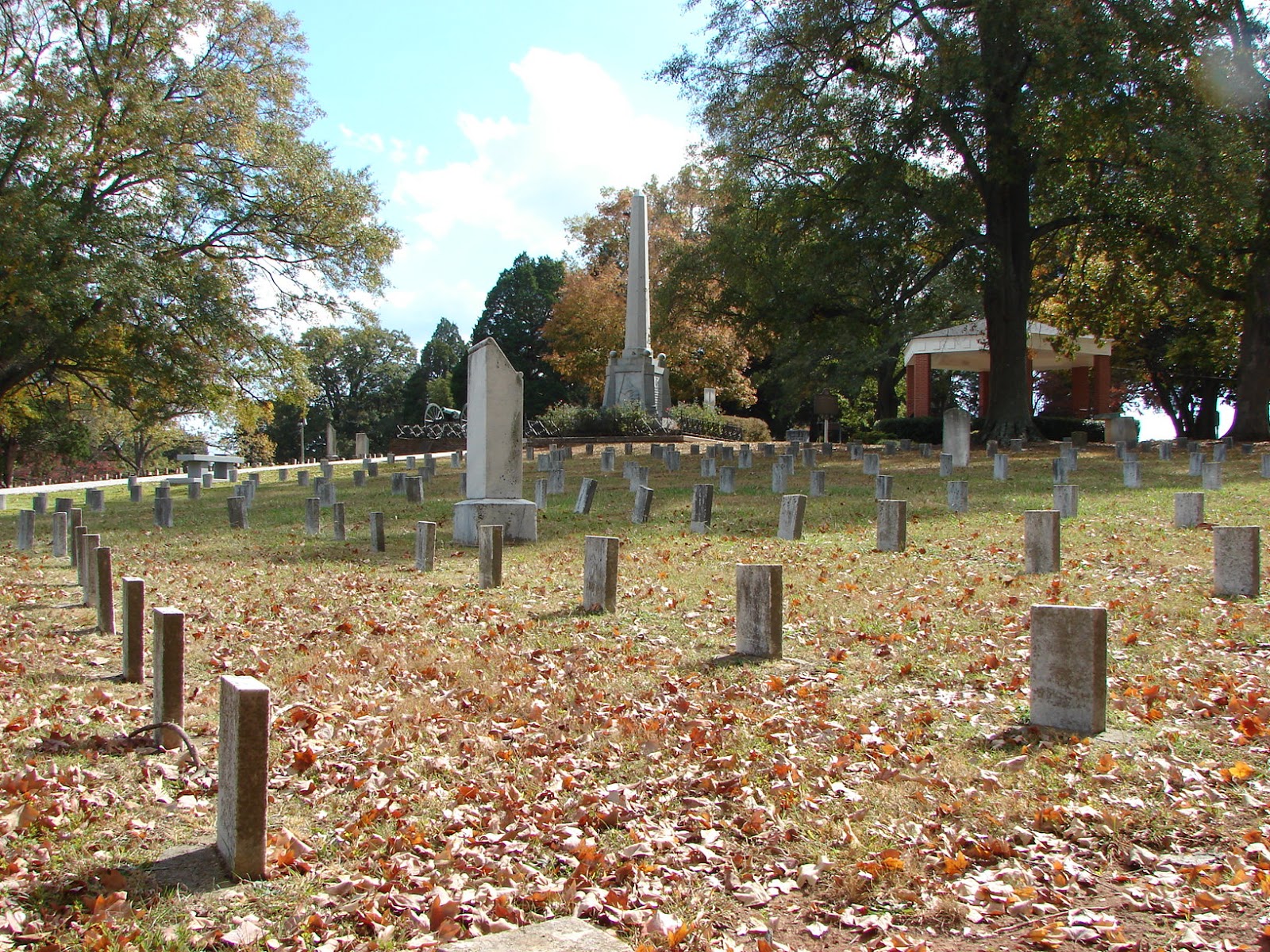
Confederate Cemetery in Marietta, Georgia, where over 3,000 Confederates are buried.

These are just a few of the photos from my wonderful trip to Georgia. Stay tuned... lots more on Georgia, the Atlanta Campaign, and Kennesaw Mountain to come...
Saturday, October 27, 2012
Georgia on my Mind
For the past few days, I have been visiting the beautiful state of Georgia. I am here doing some research and battlefield hiking to prepare for a new project that I am working on. I can't officially announce it yet, but it has something to do with the pictures below...
Oh, and by the way, I need to mention my Uncle Jeff and Aunt Paula, who are hosting me for a few days, and are wonderful, wonderful people (plus, Jeff loves it when he is mentioned on here, so I need to give him the public thanks that he and Aunt Paula so deserve!)


Oh, and by the way, I need to mention my Uncle Jeff and Aunt Paula, who are hosting me for a few days, and are wonderful, wonderful people (plus, Jeff loves it when he is mentioned on here, so I need to give him the public thanks that he and Aunt Paula so deserve!)

(Library of Congress)


Tuesday, July 12, 2011
NPR Story on Unknown Soldiers of the Civil War
Researcher IDs Remains Of Unknown Civil War Soldier
I came across this story (link is above) and thought it was worth sharing. It comes from Georgia, where a researcher claims to have identified an unknown grave on the Kennesaw Mountain Battlefield. Given my particular interest in this battle and this campaign, I had to look into it. The grave which is discussed is the one which I photographed while visiting this site this past January.

The story discusses unknown soldiers during the Civil War and how some are still searching for their identities. The main focus is on Brad Quinlan, a researcher who is claiming to have discovered the identity of an unknown soldier still buried on the Kennesaw Mountain Battlefield. Quinlan is suggesting that this soldier was "Mark Carr, 34th Illinois, 21-year-old day laborer and farmer from just outside of Dixon, Illinois." He arrived at this conclusion through studying first person accounts from the National Archives, as well as doing a process of elimination through various regimental records.
While this story is quite interesting, I have some doubts about these claims. Without further details on how this conclusion was reached, it is impossible to say with any degree of certainty, barring DNA testing, who is buried in this grave. There were dozens of Union regiments which fought in this area, making it difficult to pinpoint the 34th Illinois as the only unit whose dead fell on this spot. Nevertheless, it is an interesting story.
Stories such as this one remind us that far from the romanticized war of film, art, and tourism, the Civil War itself was a terrifying ordeal for the men who endured it. It remains important to remember that the Civil War was so brutal and vicious that some individuals simply ceased to be known as a result of it. Not only could the combined effect of shot and shell dissolve bodies with their force, but severe wounds could make recognizing and identifying soldiers difficult, and strange terrain could make finding some bodies impossible. Thus, when traveling to Civil War battlefields, remember that they still serve as cemeteries for men from both sides, and they should be treated accordingly.
I came across this story (link is above) and thought it was worth sharing. It comes from Georgia, where a researcher claims to have identified an unknown grave on the Kennesaw Mountain Battlefield. Given my particular interest in this battle and this campaign, I had to look into it. The grave which is discussed is the one which I photographed while visiting this site this past January.

The story discusses unknown soldiers during the Civil War and how some are still searching for their identities. The main focus is on Brad Quinlan, a researcher who is claiming to have discovered the identity of an unknown soldier still buried on the Kennesaw Mountain Battlefield. Quinlan is suggesting that this soldier was "Mark Carr, 34th Illinois, 21-year-old day laborer and farmer from just outside of Dixon, Illinois." He arrived at this conclusion through studying first person accounts from the National Archives, as well as doing a process of elimination through various regimental records.
While this story is quite interesting, I have some doubts about these claims. Without further details on how this conclusion was reached, it is impossible to say with any degree of certainty, barring DNA testing, who is buried in this grave. There were dozens of Union regiments which fought in this area, making it difficult to pinpoint the 34th Illinois as the only unit whose dead fell on this spot. Nevertheless, it is an interesting story.
Stories such as this one remind us that far from the romanticized war of film, art, and tourism, the Civil War itself was a terrifying ordeal for the men who endured it. It remains important to remember that the Civil War was so brutal and vicious that some individuals simply ceased to be known as a result of it. Not only could the combined effect of shot and shell dissolve bodies with their force, but severe wounds could make recognizing and identifying soldiers difficult, and strange terrain could make finding some bodies impossible. Thus, when traveling to Civil War battlefields, remember that they still serve as cemeteries for men from both sides, and they should be treated accordingly.
Tuesday, June 28, 2011
Colonel Dan McCook at Kennesaw Mountain
On June 27, 1864, William Tecumseh Sherman's massive army made a daring and futile assault upon Kennesaw Mountain, roughly 20 miles north of Atlanta. Sherman was frustrated after weeks of slow moving trench battles around Kennesaw, and decided to break the stalemate with a grand frontal assault against Confederate lines. The well entrenched Confederates met the Union attacks with a deadly barrage of infantry and artillery fire, decimating the Federal ranks. On that day, over 4,000 men would fall, and the vast majority of them were Union casualties. One part of the battlefield where the fighting was especially fierce was an area now known as Cheatham Hill. It was here where Union brigades commanded by Colonel Dan McCook and Colonel John Mitchell made a fierce attack against well fortified Confederate troops commanded by Major General Benjamin Cheatham. This hill saw desperate and brutal combat, and at the end of the day, the remaining Union attackers lay in a shallow trench they had dug to protect themselves from deadly rifle and artillery fire, not more than a few hundred yards from their enemy. Their charge would be viewed by many as one of Sherman's greatest mistakes as a commander during the war, yet, their feats that day still stand as a reminder of what courage, bravery, and duty truly mean.
On the morning of June 27th, before his men made their ill fated assault, Colonel McCook, a native Ohioan, stood before his brigade and recited the following lines from Thomas Macaulay’s poem “Horatius:”
Then out spake brave Horatius
The Captain of the Gate:
To every man upon this earth
Death cometh soon or late,
And how can man die better
Than facing fearful odds,
For the ashes of his fathers
And the temples of his gods.[1]
A veteran of the battle later recalled the moment and McCook’s quotation, as well as the effect it had on the men of his regiment: “It was, doubtless, a spontaneous quotation, but very appropriate to inspire the patriotic feeling and, if we had been Roman soldiery, a trust in the care of the gods. It was a heathen refrain, but impregnated with love of country and kith and kin and duty owed to them all.”[2] Macaulay’s poem was fitting, for shortly after McCook recited those lines, he was mortally wounded leading his men against the Confederate works. Colonel McCook had reached the Confederate works, and was leading his men over and into them when he was shot down before his troops. McCook died several weeks later on July 17, just one day after being promoted to the rank of Brigadier General.

[1] Echoes of Battle, 176.
[2] J.T. Holmes, 52nd O.V.I., 177-8.
On the morning of June 27th, before his men made their ill fated assault, Colonel McCook, a native Ohioan, stood before his brigade and recited the following lines from Thomas Macaulay’s poem “Horatius:”
Then out spake brave Horatius
The Captain of the Gate:
To every man upon this earth
Death cometh soon or late,
And how can man die better
Than facing fearful odds,
For the ashes of his fathers
And the temples of his gods.[1]
A veteran of the battle later recalled the moment and McCook’s quotation, as well as the effect it had on the men of his regiment: “It was, doubtless, a spontaneous quotation, but very appropriate to inspire the patriotic feeling and, if we had been Roman soldiery, a trust in the care of the gods. It was a heathen refrain, but impregnated with love of country and kith and kin and duty owed to them all.”[2] Macaulay’s poem was fitting, for shortly after McCook recited those lines, he was mortally wounded leading his men against the Confederate works. Colonel McCook had reached the Confederate works, and was leading his men over and into them when he was shot down before his troops. McCook died several weeks later on July 17, just one day after being promoted to the rank of Brigadier General.

Photo of Colonel Dan McCook at Cheatham Hill, Kennesaw Mountain National Battlefield Park
[1] Echoes of Battle, 176.
[2] J.T. Holmes, 52nd O.V.I., 177-8.
Friday, April 29, 2011
A January visit to Kennesaw Mountain National Battlefield Park
In early January, while I was in the midst of researching and working on my thesis, I made a several day Civil War trip to Atlanta, Georgia to visit some dear family members, hike some battlefields, and immerse myself in the few aspects of the 1864 Atlanta Campaign that I could with my available time. I thought that I would share some of my photographs and memories of that trip over the course of a few blog posts. So often, students of the war become caught up in the major battles in the east. As a ranger at Antietam, I know I fall victim to that tendency from time to time. However, the battlefields of the western armies also offer an array of excellent places to visit, study, and learn from. In many instances, such as the Atlanta Campaign, what occured in the west was just as important, if not more so, than what occured in the east. If you haven't been to some of these sites, I highly recommend making the trip. Some of the sites I visited in January were Kennesaw Mountain, the Atlanta History Center, Pickett's Mill State Battlefield, Chickamauga National Military Park, and the Southern Museum of Civil War and Locomotive History (located in Kennesaw, Georgia). I had hoped to hit a few more sites around Atlanta itself, but a snowstorm (yes, a snowstorm in Georgia) cut my trip short by a day.
Before I get to the history, I must say that this trip would not have been possible without the hospitality of my wonderful Uncle Jeff and Aunt Paula who live in Kennesaw, Georgia, just a few miles away from Kennesaw Mountain. They were extremely generous in welcoming me, and I am very blessed to have them as family.
Before I get to the history, I must say that this trip would not have been possible without the hospitality of my wonderful Uncle Jeff and Aunt Paula who live in Kennesaw, Georgia, just a few miles away from Kennesaw Mountain. They were extremely generous in welcoming me, and I am very blessed to have them as family.
Kennesaw Mountain National Battlefield Park is located roughly 20 miles northwest of Atlanta. The Battle of Kennesaw Mountain was fought on June 27, 1864, and resulted in a lopsided defeat for Major General William Tecumseh Sherman's forces. While there is a town of Kennesaw today, in 1864 it was simply the rail junction of Big Shanty, located near the town of Marietta (Big Shanty was the site where the famous railroad chase involving The General began in April of 1862). Today, the park encompasses a number of significant sites from the 1864 battle (while important spots are protected, development infringes upon the park at nearly every angle). The most striking feature of the park played a very small role in the actual fighting on June 27. Big Kennesaw, the primary mountain, was not the object of any major frontal assaults that day, and anyone who has seen it can easily figure out why. As any visitor can tell, it is clearly the most imposing feature of the landscape, and it has a summit of roughly 1,800 feet. The options for getting to the top include both hiking and driving. On my visit, I decided it was better to drive to the top, as it was a chilly day and I didn't feel like making the several mike hike...

Once on top of Kennesaw Mountain, the view is tremendous. It was my good fortune that after flying from Cleveland to Atlanta I happened to go to the top on a cloudy and dreary day, impeding my view of the surrounding area. The above photograph shows one part of the mountain's excellent view. In the distance (although not clearly visible in the photograph) is downtown Atlanta, with Stone Mountain (the largest piece of exposed granite in the world, beautifully adorned with the engraved images of Robert E. Lee, Stonewall Jackson, and Jefferson Davis) off to the left hand side of the picture (barely visible).

All along the summit of the mountain are remnants of gun emplacements made by Confederate soldiers dating back to the battle in 1864. My journey to the top was made in a comfortable car on a paved and winding road; such was not the case for the Confederate artillerymen of Joseph Johnston's Army of Tennessee. These artillery positions atop the mountain have a remarkable view of the surrounding area. During the several week long standoff between the two armies near Kennesaw Mountain in June of 1864, artillery duels were a daily occurence, as each side made use of the mountainous terrain to lob shells at enemy gunners. In fact, on June 14, at nearby Pine Mountain (the name is deceiving, it is not as much a mountain as a large hill), Confederate Lieutenant General Leonidas Polk was killed instantly by an artillery shell fired by an Indiana Battery. According to eye witness reports, Sherman himself ordered the shelling, as he and others spotted Polk along with General Johnston and General William Hardee. Polk was also an episcopal priest, and one of the more eccentric generals in gray during the war. Needless to say, the story illustrates the effectiveness of long range artillery during the campaign, of which the above photograph shows one piece.

In my opinion, the most impressive part of the Kennesaw battlefield is the area known as Cheatham Hill, named after Confederate Major General Benjamin Cheatham, whose men defended the position during the battle. The above picture shows the Illinois monument at that location. Several hiking trails criss-cross the area, and it is a very picturesque place. In the background is the open field over which Union soldiers from Major General John Palmer's 14th Corps charged on the morning of June 27, 1864. It sits at the focal point of Colonel Dan McCook's brigade's attack that day. McCook's brigade was composed of men from both Illinois and Ohio, but the first lines of assault were composed primarily of Illinois troops. The Illinois monument is one of the few that exist on the Kennesaw battlefield. There are also monuments to men from Georgia and Texas.

This photograph, taken at the base of the Illinois monument, shows what remains of a tunnel dug by Union soldiers in the aftermath of their attack on Confederate positions on Cheatham Hill. As the Union attack lost momentum against the Confederate trenches, a large number of the Federal troops chose to dig in rather than fall back to their starting position. At a distance of less than 100 yards from the Confederate lines, men from Ohio and Illinois dug trenches with their hands, bayonets, cups, plates, and anything else they had access to. Initially, the trenches were not very sophisticated, as the primary goal during daylight hours was to shelter oneself from enemy fire. However, once the sun set, tools were brought up and the trenches were strengthened. On June 29, a truce was called so that the dead of both sides could be buried. Other than that truce, there was little respite from the constant strain of lying so close to enemy works. As can be seen in the picture above, during that period of time an effort was made to dig a tunnel underneath the Confederate lines so as to detonate explosives and end the stalemate. Confederate evacuation of the line on July 2 made such an effort unnecessary, but the opening of the tunnel still remains to this day on the battlefield.


Along side a hiking trail near the Illinois monument rests the lone grave of an unknown Union soldier, fittingly adorned with American flags and remembrances. The setting of this soldier's grave is really quite remarkable. Rarely does one find a marked grave still on an actual battlefield. Yet here this unknown soldier lies, in all likelihood not far from where he fell during the battle. As the soldier's identity is not known, it is impossible to say which regiment or state he was from, but based on maps of the Federal movements on June 27, it is likely that he was a soldier from Dan McCook's brigade of the 14th Corps. Such a sight gives one cause to stop and reflect on the meaning of what occured at such a hallowed place.

A short distance from the Illinois monument, one can still see what is left of Confederate trenches from 1864. These trenches are a common sight on the battlefields of that year, as 1864 saw a major transition away from open field assaults towards trenches and defensive warfare.

This photograph allows for a more detailed veiw of those same Confederate trenches. It is difficult to guage their depth, but I would estimate that this specific portion was still at least 2 to 3 feet deep (not bad considering they are about 150 years old). As with any remaining historical features at a Civil War battlefield, it is always best to observe and leave well alone so as to allow future generations of visitors to enjoy the same remnants of battle from so long ago.
I will post more photogrpahs from this trip in the days and weeks to come (even a few more from Kennesaw Mountain). As my thesis on the 1864 Atlanta Campaign is now complete, think of this as a way for me to reflect on my past few months of work while I prepare to switch gears back to 1862 for another season at Antietam.
For more information on the Kennesaw Mountain battlefield, visit the Kennesaw NPS website here.
For more information on the Kennesaw Mountain battlefield, visit the Kennesaw NPS website here.
Subscribe to:
Posts (Atom)